Showing posts with label Pauling. Show all posts

Tuesday, July 22, 2014

Londoners are not in Top Gear


By Laurel Pauling

LONDON — Despite England being host to the world's most popular motoring show, London is not a car friendly city. 

The average price of gas in London is currently £1.30 per liter, according to BBC News. That is the equivalent of $8.40 per gallon, more than double the average cost in the United States, as reported by the Independent Statistics & Analysis U.S. Energy Information Administration. If gas prices alone were not enough to deter people from driving cars in the city, there is also the congestion charge.

Drivers must pay this £11.50 fare every time they drive into a specific zone during designated times. The congestion charge was put in place by former London Mayor Ken Livingstone in February of 2003, following the Road Traffic Reduction Act of 1997. Driving in London is still a challenge, with large buses and countless taxis filling the roads. As a result, most Londoners choose alternate transportation.

"I don't know that I can afford a car," said Molly Barrett, who has lived in London on and off since college. "And it doesn't look like it would save much time to drive," she added.

Barrett said that of everyone she knows in London, only two own cars. And when they do use them it is only to drive out of the city. For inner-city transportation they walk or ride the Tube, she said.

In 2012 alone the London Underground, commonly referred to as the Tube, carried 1.107 billion passengers, according to the Telegraph. Out of the 8 million residents of London, about 3 million owned cars in 2010. Car ownership in the city is also falling, according to London Councils.

Daniel Wires, a resident of London for almost three years, said his primary modes of transportation are walking and taking the bus. He does not own a car either, due to the extreme congestion and a general distaste for driving. People who live in the center of London generally do not own cars, he said.

Wires also dislikes the tube.

"I hate the Underground. It's dark, it's crowded, it's uncomfortable," he said.

Wires, who lived in a smaller city prior to moving to London, is not alone in favoring above ground transportation. Andrew Adonis, reporter for The Independent, said double the number of people take the bus in London than ride the tube every day. There are an average of 2.3 billion bus journeys taken per year, Adonis said. The London Councils also report that 90 percent of Londoners live within 400 meters of a bus stop.

When a car is necessary, a fleet of 23,000 elite cab drivers await.

The black cabs of London are unlike any other taxi service in the world. Drivers must memorize 25,000 streets and undergo six months of testing before becoming certified. Minicabs are another option, and these two types of taxis take Londoners wherever they need to go.

With this much public transportation and so few cars, Londoners walk often as well. Seeing business attire paired with sneakers is not uncommon during the morning and evening rush hours. Barrett said she used to walk an hour and 40 minutes to and from work each day.


"But I think I'm probably an outlier," she laughed.

Sunday, July 20, 2014

Muggles in London


By Laurel Pauling

Heading for the Hogwarts Express at Platform 9 3/4
LONDON -- Muggles travel from around the world to experience the magic of London. The infamous Harry Potter novels have strong ties to the city, because events throughout the series take place here. Many scenes for the movie adaptations were filmed on location as well. According to Visit London, there are six places fans can go and retrace Harry’s steps through the books. Filming for Platform 9 3/4, where young wizards and witches board the Hogwarts Express, took place at St Pancras station. At King's Cross station, where the platform existed in the books, there is a replica Platform 9 3/4 were you can dress up and take pictures as you prepare to run through the wall.

The Millenium Bridge
The Tower Bridge
The Leadenhall market was used for several of the Harry Potter films, and was portrayed as Diagon Alley and as the entrance to The Leaky Cauldron. At the London Zoo, the scene with Harry and the snake was filmed for The Sorcerer’s Stone. London bridges can also be spotted in the movies. In The Order of the Phoenix, Harry flies over the Tower Bridge on his broomstick. The Millenium Bridge is destroyed by death eaters in the seventh movie, and the Knight Bus squeezes through the Lambeth Bridge. Piccadilly Circus and the Westminster Tube station were also featured in the films.

The Bodleian Library, Oxford
With the growth in popularity of the Harry Potter series, London has experienced a growth in tourism. According to tourism marketing agency VisitBritain, fans spend a total of around 6.5 billion pounds in the UK during their stay. According to the agency, Americans spend more than one billions pounds on their Potter-centered trips, more than any other country. Tourists visit places outside London as well, helping boost the economies of smaller towns like Oxford, where interior shots of Hogwarts were filmed, and Northumberland, where Ainwick Castle, used for exterior shots of the school, is located.

Friday, July 18, 2014

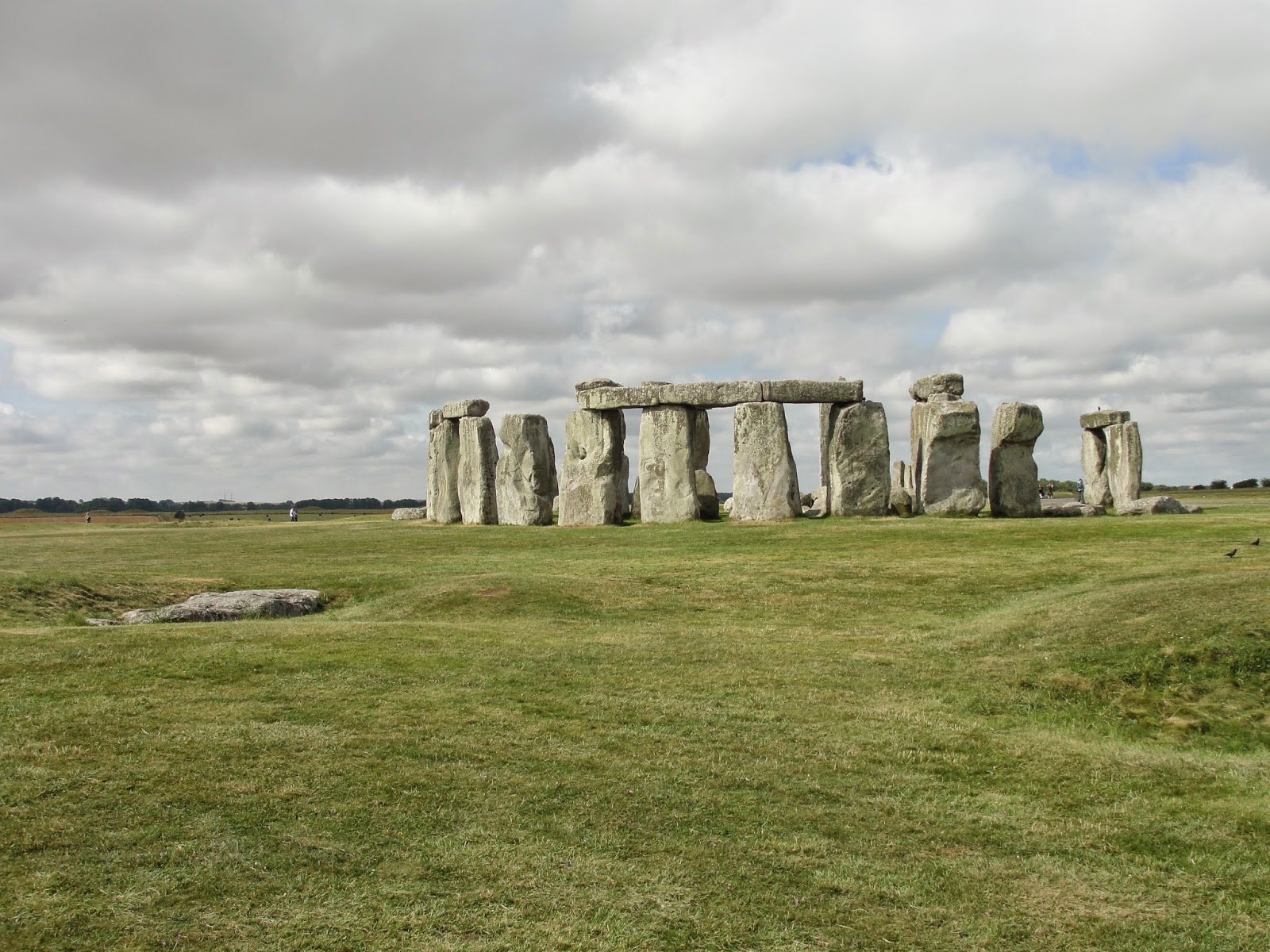
Stonehenge: Not Just a Lesson in History


By Laurel Pauling

AMESBURY -- Prior to seeing significant historical sites or going to places like famous monuments and museums, I am not usually thrilled. I know that they're important and impressive, and generally I enjoy visiting them and learning about their significance. I just feel like I'm less awed than most people. As our coach neared Stonehenge, I felt like I should be more excited to see this infamous monument. I prepared myself to experience this again, but when we reached the circle of ancient stones I was shockingly awed.


Driving the rural road through the English countryside we crested a hill and Stonehenge suddenly appeared in the distance. While the monoliths seemed smaller than I had imagined, their size has nothing to do with what makes them remarkable. Rather than a tour guide we were given audio sets that allowed us to take in the landmark at our own pace. As I began the tour, walkie-talkie-sized device held up to my ear, I found myself genuinely interested in the facts and stories the voice was telling me about Stonehenge: Why it was built, how, what it's main purpose was, and what rumors about it are true. Walking through them is now prohibited due to vandalism and conservation efforts. However, the path took me quite close and I had a view from every angle. Unlike my previous experiences in museums and at monuments, I was captivated by this recorded history lesson.

Between each segment the audio would stop, and I had time to take in my surroundings (and take pictures). During these moments, the magnitude of what I was seeing would sink in. There are some traffic noises from the freeway, and the babble of voices in many languages, but as I became absorbed in my surroundings those distractions faded into the background like white noise. I felt peaceful as I wandered around the stones, sitting in the gently waving grass under the blue, cloudy sky.


Despite my previous expectations, I did not find myself bored at any moment, or wanting to be the first to leave. Instead, I wandered around slowly and enjoyed all the time I had to take in the incredibly impressive structure, and listened intently to what I was learning about it. Something about the extreme complexity hidden under the simplicity of the stones was intriguing to me. It made me realize why close to a million people come to the site each year.

Maybe some of these people were history fanatics who know all about ancient culture and have made it a lifelong goal to see this famous testament to human achievement. But maybe some of these people were like me, having arrived here initially feeling they should be more interested than they were.

 After my visit, I learned that you can be a combination of both of those types of people, and find interest and serenity in a topic you don't normally enjoy. I hope Stonehenge taught those people like me the same thing, too.


Wednesday, July 16, 2014

Toffee, Toasties and Take Away: Food in London


By Laurel Pauling

LONDON -- After traveling for almost 21 hours, one of the main things on my mind once I reached my apartment in London was eating something other than airplane food. My first meal in the city was a huge improvement. We had a group meal at Ship Tavern, which opened in 1549 and was used as a secret meeting place for Catholic mass during the reign of King Henry VIII. We were offered a choice of several meals, including "bangers and mash," a traditional British dish of mashed potatoes and sausage, and several varieties of pies.


Chicken pie, mashed potatoes and vegetables


A "pie" in Britain is what Americans know as a pot pie, and they're a very popular dish. I chose a chicken pie as my dinner, and it was better than any I've had at home. The flaky pastry crust was delicious, and it was filled with large pieces of chicken in a thick, creamy sauce. We were also offered dessert at the tavern, and I chose sticky toffee pudding, something I had never heard of but that was highly recommended to me by both my professor and one of our guides.

Sticky toffee pudding


Since the dessert had the word pudding in it, what I got was not what I was expecting. It had the constancy of a moist, crumbly brownie, and came with butterscotch sauce and vanilla ice cream. This was obviously very different than the creamy chocolate or tapioca dessert I associate with the word pudding, but in Britain the word pudding is used in place of the word dessert. It was unlike anything I've tasted before, and it was rich and very sweet.

For lunch on our second day, some of the group stopped at Pret A Manger, a chain restaurant that exists in the states on the east coast as well as in Hong Kong, and that is very popular in England and France. They have pre-made sandwiches, wraps, fruit cups, salads, and other quick foods that you grab off a shelf and either take to go, or sit down with in the restaurant. I was surprised to find that there was a price difference between getting food for take away, the British term for "to go," and eating at the cafe-style restaurant, which was the more expensive option.

Ham, cheese and mustard toastie


I picked up a ham and cheese sandwich with mustard that said it would be warmed up, and when it was given back to me I recognized it as a panini. The word used by Pret for the sandwich is a "toastie." According to the information on the bag, toasties have been a favorite food of the British people for the last 30 years. My toastie was a more gourmet version of the ham and cheese melts I have made as lunch for myself at home, although there were many more diverse options.

So far, my meals in London have more than made up for the ones I ate getting here.